IPTV Price Comparison: 7 Costs That Matter in 2026
Published September 14, 2026Updated September 14, 2026By Robert M.
Table of Contents
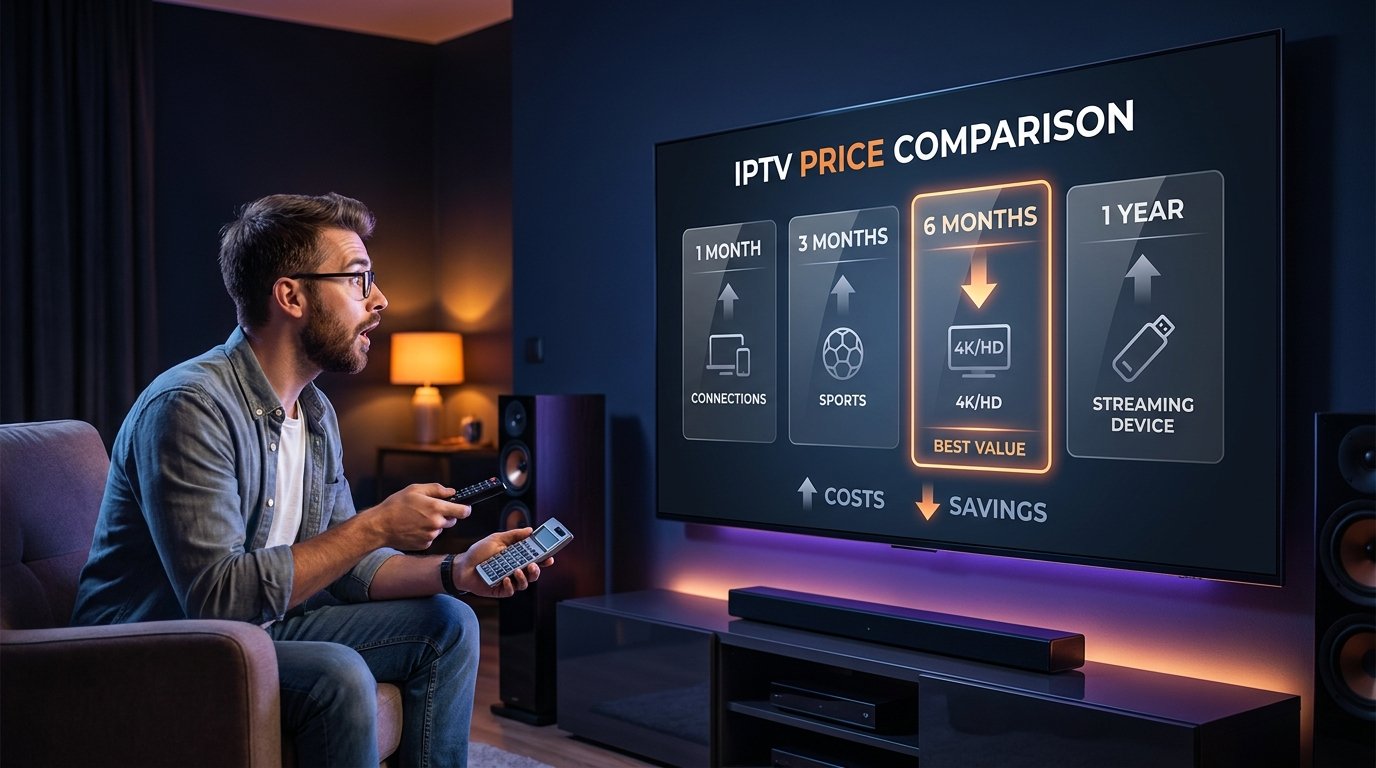
A useful IPTV price comparison is not a race to find the smallest number on a pricing page. Two subscriptions can have similar headline prices while offering very different value once you include plan length, simultaneous connections, channel relevance, sports coverage, device compatibility, player costs, hardware requirements, streaming quality, and customer support. The cheapest-looking provider can become the more expensive option after those differences are counted properly.
The biggest mistake in an IPTV price comparison is treating every plan as if it were equivalent. A one-month single-connection package should not be compared directly with a twelve-month multi-screen plan without adjusting for the extra commitment and features. The right question is not “Which provider is cheapest?” It is “What am I actually getting for the total amount I pay, and how much of that setup will I genuinely use?” That is the foundation of a useful IPTV price comparison.
Quick Answer: What Should an IPTV Price Comparison Actually Include?
A practical IPTV price comparison should include the subscription total, plan duration, simultaneous connections, must-have channels, sports coverage, device compatibility, any paid IPTV player, new streaming hardware, network upgrades, stream reliability, support, and any other subscriptions you still need because the IPTV plan does not replace them.
For new users, a short plan can have better value even when its monthly equivalent is higher because it limits the amount committed before the provider has been tested. For established users who already know a service performs well, a longer term may offer stronger effective value. If Apollo Group TV is one of the services you are evaluating, use the current pricing page as the live pricing reference rather than relying on an old screenshot or article.
Start With the Real Cost Formula
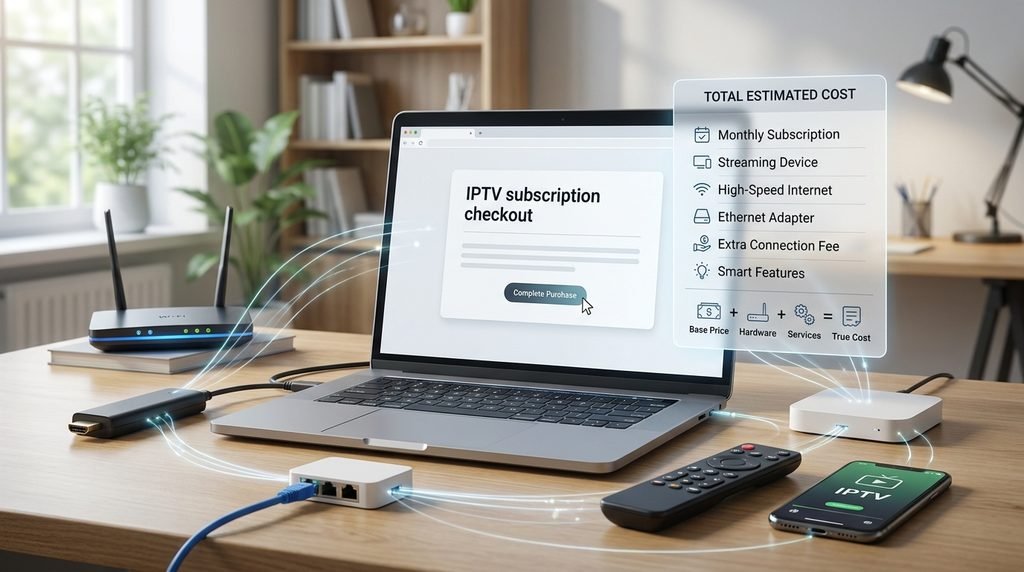
The most useful IPTV price comparison begins with the complete setup cost rather than the subscription alone. A low base price can be misleading when the user must also purchase a premium player, replace an old streaming device, add another connection, buy an Ethernet adapter, or keep separate subscriptions for channels the IPTV service does not cover.
A simple formula is more useful than a headline monthly number: subscription + required player + required hardware + connection upgrades + other subscriptions you still need = real setup cost. That formula makes an IPTV price comparison fair because it compares complete viewing setups instead of isolated subscription cards.
Cost Area
What to Include
Why It Matters
Subscription
Total plan price
Base cost of the service
Player
Premium or activation fee if required
Separate from provider subscription
Hardware
Firestick, TV box, Ethernet adapter
May raise first-year cost
Connections
Extra simultaneous streams
Important for couples and families
Missing content
Other services you still keep
Reduces theoretical savings
Support/reliability
Time and inconvenience from problems
Hidden cost of a poor service
Headline Price vs Real Cost
A provider can appear inexpensive until the complete setup is added together. A more expensive subscription may become the stronger IPTV price comparison choice when it already supports your devices, includes the connection count you need, works with a player you own, and covers channels that would otherwise require another paid service.
Monthly vs Three, Six, and Twelve Months
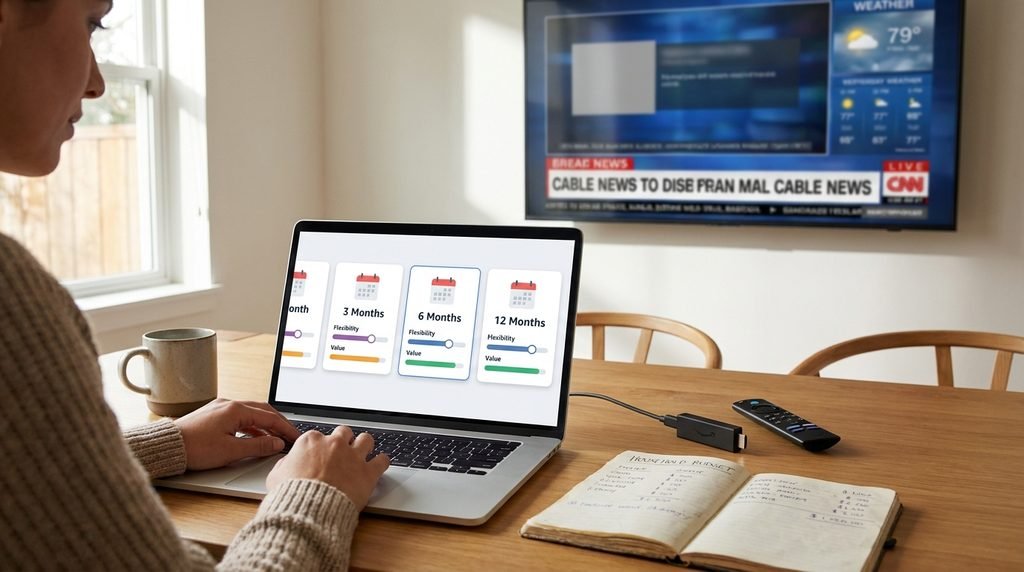
Subscription length changes both the effective price and the amount of risk. In almost every IPTV price comparison, the monthly plan looks more expensive when projected across a full year, while six- or twelve-month packages can reduce the effective monthly rate. The trade-off is that long plans require more money upfront and give you less flexibility if performance deteriorates or the service simply does not fit your needs.
For a first-time buyer, flexibility has financial value. Paying slightly more for one month can be smarter than paying less per month for a year if the short plan prevents a bad long-term purchase. A twelve-month plan makes much more sense after the provider has already proven itself on your real television, internet connection, sports schedule, and normal evening usage.
Plan Type
Best Fit
Main Advantage
Main Risk
Trial / short test
First evaluation
Very low commitment
May be too short for full testing
1 month
New customer
Maximum flexibility
Higher effective monthly cost
3 months
User who passed initial testing
Balance of value and flexibility
Moderate upfront payment
6 months
Satisfied regular user
Fewer renewals
Larger commitment
12 months
Proven long-term user
Potential best yearly value
Highest upfront exposure
When Monthly IPTV Makes More Sense
A monthly plan deserves extra credit in an IPTV price comparison when you are testing a new provider, using a new Firestick or Smart TV setup, unsure about sports coverage, comparing several services, or waiting to see how the provider performs during peak evening hours. The extra monthly cost can function like insurance against a larger bad commitment. In a first-time IPTV price comparison, that flexibility has real value.
When Twelve Months Can Be Better Value
A long plan becomes easier to justify after months of successful use. If important channels remain available, live sports perform reliably, your player and devices behave well, and support has been useful when needed, the lower effective monthly rate becomes more meaningful. At that point, the IPTV price comparison is based on your own evidence rather than marketing.
Measure Channel Value, Not Channel Count
A huge channel count can make one service look more valuable than another, but most households repeatedly watch a relatively small number of channels. The stronger IPTV price comparison begins with your actual viewing list rather than whichever provider advertises the largest catalog.
Write down the categories your household uses: U.S. or international news, live sports, entertainment, films, children’s television, regional programming, or specific countries. If Apollo Group TV is on the shortlist, review the current Apollo Group TV channel lineup and compare it against the channels you genuinely watch.
Ask What the Subscription Actually Replaces
A useful question is not “How many channels do I get?” but “How many services can this realistically replace?” If an IPTV package covers live television, sports networks, and international channels that would otherwise require several separate subscriptions, its higher headline price may still create a better IPTV price comparison result.
The opposite can happen too. A cheap provider that misses important channels may force you to keep additional subscriptions, reducing or eliminating the apparent savings. A low IPTV price has little value when it does not replace anything you currently pay for. A practical IPTV price comparison should measure replacement value, not catalog size.
Firestick, Smart TV, Player, and Hardware Costs
The subscription may not be the only thing you need to buy. Firestick, Android TV, Google TV, Samsung Smart TV, LG TV, Apple TV, and other platforms can require different players or setup methods. Before choosing a service, review the device installation instructions and understand what your current hardware needs.
If you already own a suitable streaming device and compatible player, the subscription may represent nearly the whole cost. If the current television is too old, Wi-Fi is unreliable, or a premium player is required, those expenses belong in the first-year IPTV price comparison.
IPTV Player Fees Are Separate From Provider Fees
Some third-party IPTV players charge for premium features or activation. Those charges are not the same as the provider subscription. A cheaper provider that requires a paid player can lose part of its price advantage compared with a slightly more expensive service that works with software you already own.
This is why the formula subscription + player + hardware + connection upgrades creates a more honest IPTV price comparison than the subscription price alone.
HD and 4K Value Without Falling for Labels
Resolution labels can make one package appear more premium, but paying extra for 4K only creates value when the real stream quality justifies it. Source resolution, encoding, bitrate, provider delivery, internet quality, player performance, streaming hardware, and television capability all affect the final picture.
In an IPTV price comparison, stable Full HD can be better value than unstable 4K. A higher-resolution label means very little if the stream freezes, changes quality constantly, or performs poorly during motion. Quality should improve the IPTV price comparison only when it improves real viewing.
When Higher Quality May Be Worth Paying For
Paying more can make sense when you own a large 4K television, regularly watch high-quality sports or films, have a stable broadband connection, can clearly see the improvement, and use hardware capable of handling the streams reliably. If most viewing is ordinary live television on a smaller screen, a more expensive 4K-focused package may provide little additional value.
Support, Activation, and Reliability as Hidden Value
Two providers can offer similar channel catalogs and completely different experiences when something breaks. Support has economic value because time spent troubleshooting is still a cost. A slightly cheaper provider with no useful support may become more expensive in frustration when authentication fails before an event or a billing issue cannot be resolved.
If Apollo-related subscription or setup questions come up during your IPTV price comparison, you can contact support through WhatsApp before buying. Clear answers about setup, devices, or account rules can prevent a poor purchase.
Fast Activation Is Useful, but Only Once
Instant activation can be convenient when the device is already prepared, but activation speed should not dominate an IPTV price comparison. Saving ten minutes on the first day matters far less than stable viewing over the next several months.
IPTV vs Mainstream Streaming Cost
U.S. viewers often compare IPTV-style subscriptions with cable-replacement services and individual streaming apps. These are not identical products. Mainstream services usually provide polished apps, standardized billing, and clearer licensing structures, while IPTV-style providers may emphasize larger international lineups, different channel mixes, or more setup flexibility.
A fair IPTV price comparison should look at the entire entertainment budget. If a mainstream service costs more but allows you to cancel several other subscriptions, the higher headline price may not matter as much. Likewise, a lower-cost IPTV package can be strong value when it genuinely replaces most of what the household watches.
Cheap vs Premium IPTV
The words “cheap” and “premium” do not guarantee performance. A cheap provider can deliver excellent value when it has the channels, stability, device compatibility, and support you need. A premium provider can justify a higher price when it adds genuinely useful connections, stronger support, better applications, or more reliable streams.
Question
Cheap Plan
Premium Plan
Does it include my channels?
Must verify
Must verify
Is it reliable?
Must test
Must test
Does it support my device?
Must confirm
Must confirm
Are multiple streams included?
May cost extra
May be included
Is 4K useful?
Depends on actual quality
Still depends on actual quality
Is support usable?
Varies
Should justify some premium
The same checks belong on both sides of an IPTV price comparison. Paying more does not guarantee better service, and paying less does not automatically mean worse service.
Why a Trial Can Have Real Financial Value
A free or inexpensive trial can be one of the most valuable parts of an IPTV price comparison because it reduces the risk of a bad long-term purchase. Testing on the real television, player, network, and evening viewing schedule gives you information that a pricing page cannot provide.
Use the evaluation period to test must-have channels, live sports, guide navigation, longer viewing sessions, and normal household conditions. A trial that prevents one poor twelve-month commitment can save more money than choosing the cheapest annual package immediately.
Check the Trial Terms Too
Confirm how long the trial lasts, whether payment details are required, what connection limits apply, and whether anything renews automatically. Trial conditions are part of the IPTV price comparison because a “free” test can still create confusion if the terms are unclear.
Hidden Costs Most Price Tables Ignore
Additional expenses can include premium player activation, a new streaming device, extra connections, Ethernet adapters, networking equipment, currency-conversion charges, and separate services needed for missing content. Not every user will encounter all of them, but they belong in an IPTV price comparison whenever they apply.
A provider advertising a low base price should not be compared directly with another plan containing more screens and features without adjusting for those differences. Equivalent setups should be compared against equivalent setups. Without that adjustment, an IPTV price comparison can make the cheaper-looking plan seem better than it really is.
Final IPTV Price Comparison Matrix
The easiest way to finish an IPTV price comparison is to score each provider against the factors that would actually change your decision. Price should be one row in the matrix, not the entire matrix.
Decision Area
Question
Good Sign
Total cost
What will the complete setup cost?
No important hidden expenses
Duration
Does commitment match confidence?
New users are not locked in too early
Channels
Does it cover what you actually watch?
High replacement value
Sports
Do major events perform reliably?
Stable peak-time viewing
Connections
Does the plan fit household overlap?
No unnecessary or missing streams
Device cost
Do you need new hardware or a paid player?
Low extra setup cost
Quality
Are HD/4K labels backed by stable playback?
Useful quality rather than marketing
Support
Can account problems be resolved?
Clear support route
Trial
Can you test before a large commitment?
Risk can be reduced
Frequently Asked Questions About IPTV Price Comparison
What is the best way to do an IPTV price comparison?
Compare total subscription cost, duration, channels, sports, simultaneous streams, device compatibility, player fees, hardware, streaming reliability, support, and any other services you still need. The strongest IPTV price comparison looks at the full setup rather than the advertised monthly number.
Is monthly IPTV more expensive?
Monthly plans can have a higher effective monthly rate than long plans, but they also reduce the amount committed upfront. For a new user, that flexibility can make the monthly option financially smarter even if the annual projection looks higher.
Is a twelve-month IPTV plan cheaper?
It may provide a lower effective monthly rate depending on the provider. However, the yearly plan normally makes more sense after the service has already been tested. A good IPTV price comparison includes the risk of committing too early.
Should I choose the cheapest IPTV plan?
Not automatically. Choose the least expensive plan that still satisfies your channels, device setup, simultaneous connections, quality expectations, reliability needs, and support requirements.
What is a good IPTV price?
There is no universal number. A good price depends on how much useful viewing the service delivers relative to the alternatives you would otherwise pay for. A solo occasional viewer and a sports-heavy family should not expect the same ideal price.
How do I compare IPTV with cable or mainstream streaming?
Compare the complete entertainment budget rather than one subscription. Count the services you will cancel, the ones you will keep, hardware costs, device quality, support, and the licensing or billing structure that matters to you.
Final Verdict: IPTV Price Comparison in 2026
The best IPTV price comparison does not produce one universal cheapest provider because different households buy different combinations of channels, devices, connections, sports, and support. A solo Firestick user, a family with three televisions, and a sports fan following several leagues should not expect the same plan to deliver the best value.
Start with what you actually watch. Then compare subscription duration, simultaneous streams, device and player costs, installation requirements, reliability, picture quality, support, and any other subscriptions you still need. Only after those requirements are clear should the advertised price become the deciding factor.
For new users, a short plan can be worth more than the lowest annual rate because it protects against committing too early. For users who have already tested a provider and know it works well, a longer package may provide stronger effective value and fewer renewals. That is the difference between finding the lowest advertised price and performing a useful IPTV price comparison: one tells you which number is smallest, while the other tells you which complete setup is likely to give you the most value for the money you actually spend.